






From Excel-Based Reporting to a Structured ERP and Data Platform
Stabilize operations with ERP. Then make reporting fast, consistent, and reusable.
The client prefers to remain unnamed. Protecting client information is simply part of how we operate.
Case narrative
Project overview
The client was using an accounting system that could no longer support growing business and reporting needs.
As requirements increased, Excel became the main reporting tool. Macros, manual work, and repeated data entry were used to keep things running.
With overseas branches involved, collecting and consolidating data became slow and error-prone.
The challenge
Reporting was built around spreadsheets, not systems.
- Key reports relied on manually maintained Excel files
- Macros were required to complete monthly processes
- Data entry was duplicated across teams
- Reporting logic depended on individuals
- Small changes could break existing reports
As the business expanded, reporting became a recurring manual task: collecting files, aligning formats, and rebuilding calculations every cycle.
There was no stable or scalable reporting foundation.
The solution
ST Systems delivered the project in two phases.
Phase 1: ERP foundation

Microsoft Dynamics 365 Business Central
ERP used as the operational core and system of record.
- Migrated historical and operational data
- Standardized accounting and business processes
- Established a consistent data structure across entities
This created a stable foundation for daily operations.
Phase 2: Data and reporting layer
After stabilizing operations, we built a modern reporting architecture.

Apache Airflow
Runs scheduled workflows and manages multi-step data processes.

Airbyte
Extracts and syncs data from source systems into the warehouse.

Snowflake
Centralizes and structures data for reporting and fast queries.

Power BI
Delivers dashboards and reports for practical business use.
ERP handles operations. The data platform handles reporting.
This separation reduces manual work and makes reporting consistent and scalable.
Results
The client moved away from spreadsheet-driven reporting.
Manual work and duplicate entry were significantly reduced
Excel macros are no longer critical to operations
Data is centralized across all branches
Reports are faster to create and easier to reuse
Most importantly, the numbers became more reliable.
Because the process—from operations to reporting—is now clear, structured, and repeatable.
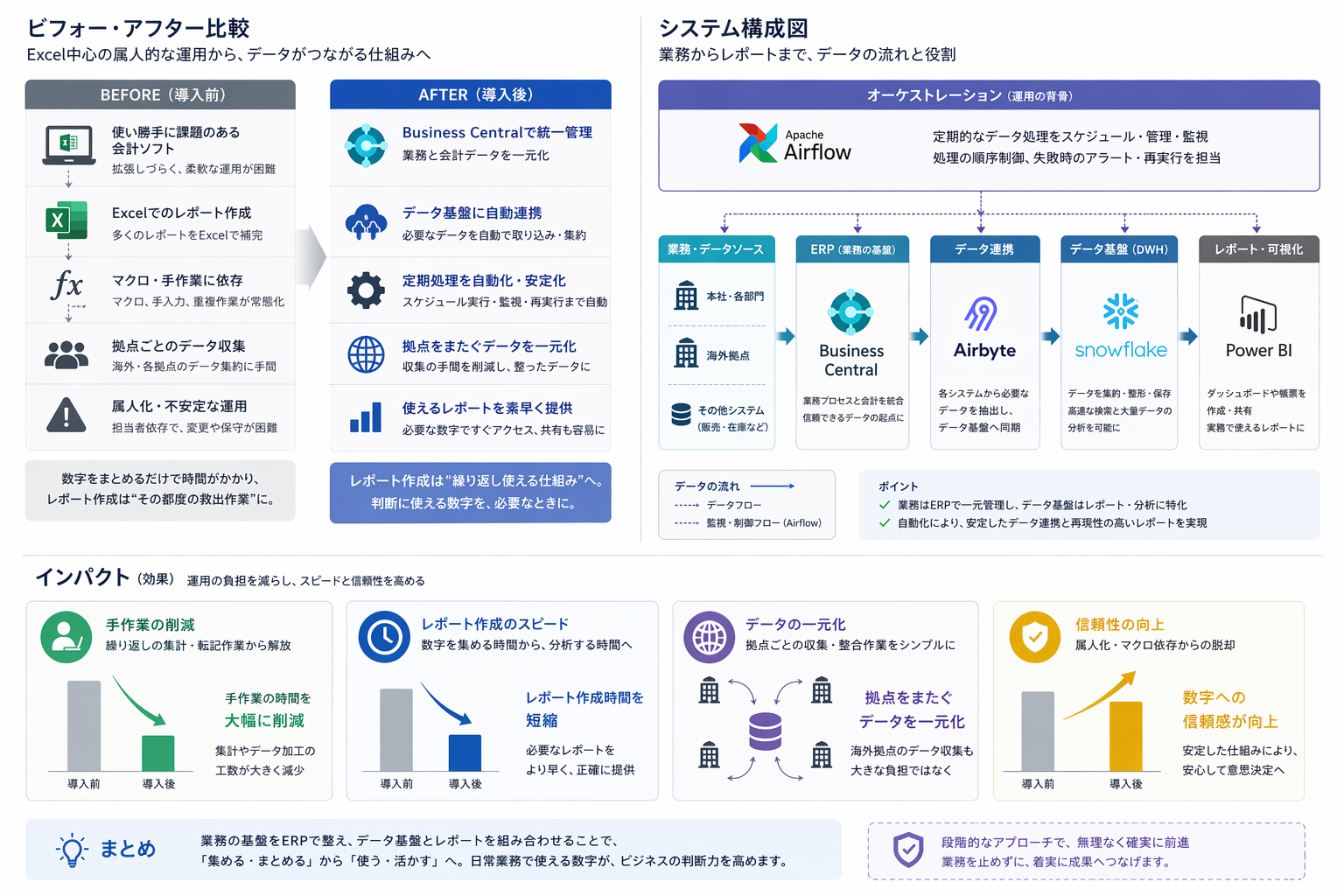
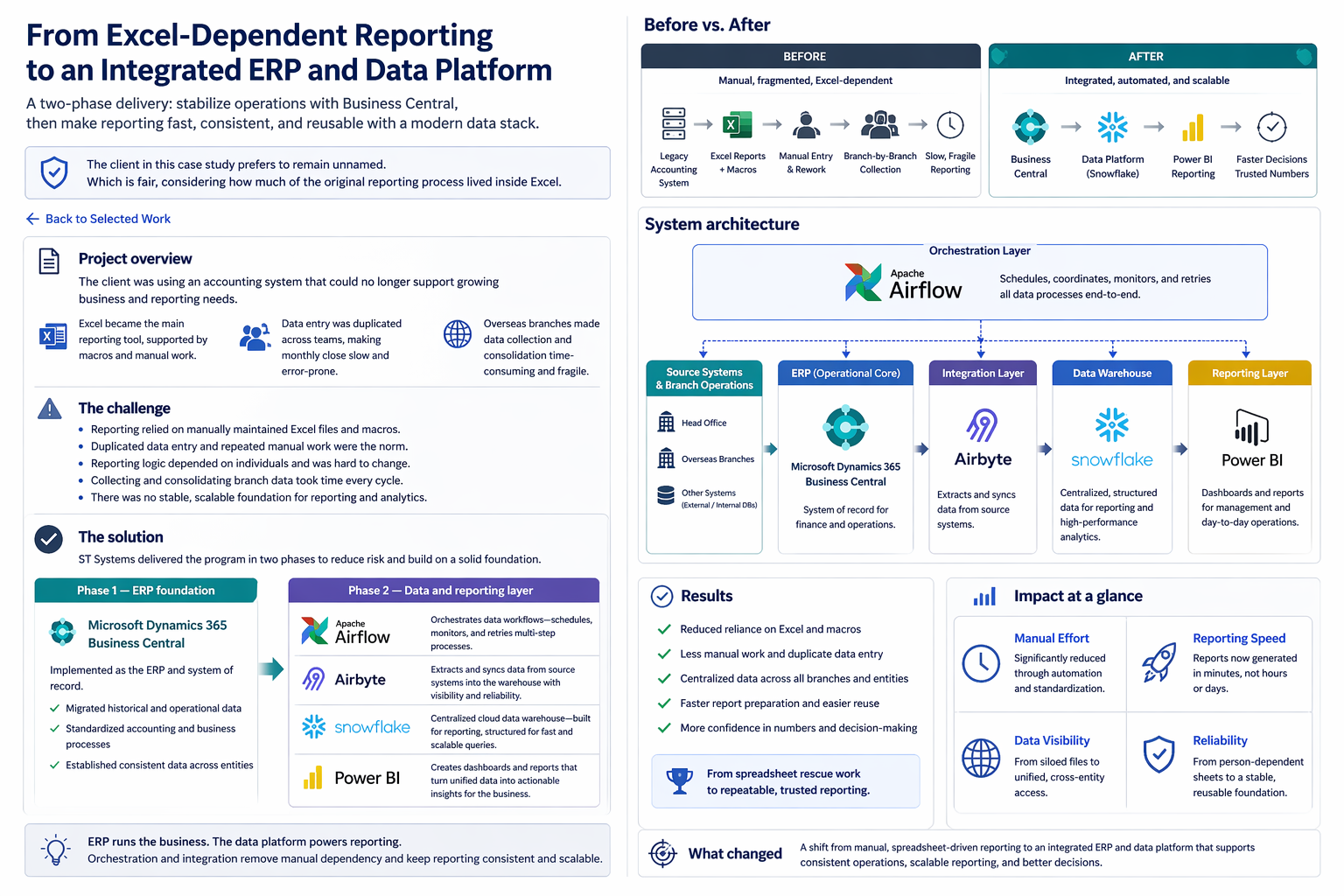
Before / After (high level)
Before
- Legacy accounting software
- Excel reporting as the default
- Macros holding the process together
- Manual entry and duplication
- Branch-by-branch collection
- Fragmented data
After
- Business Central as system of record
- Airflow-managed scheduled workflows
- Airbyte sync into Snowflake
- Power BI dashboards for management
- Centralized consolidation
- Automation that reduces rework
This is a simplified view of what changed. The goal wasn’t “more tools”—it was fewer manual steps, clearer ownership of data, and reporting that doesn’t depend on macros and memory.
System relationship diagram
Operational core
Business Central (ERP) remains the source of record for operations—kept lean so day-to-day work stays reliable.
Reporting layer
Snowflake (warehouse) + Power BI (reporting) focus on consistent reporting—without putting analytics load on the ERP.
Impact
Consolidation
From branch-by-branch collection to centralized access.
Reporting speed
From ad-hoc rebuilds to reusable dashboards and definitions.
Confidence in numbers
From person-dependent logic to clearer sources and repeatable steps.